Leave Your Message

Top 10 Battery Test Chamber Features You Should Know?

In the rapidly evolving world of electric batteries, understanding the intricacies of a Battery Test Chamber is crucial. Industry expert Dr. Emily Collins emphasizes, “The right features in a Battery Test Chamber significantly enhance safety and accuracy.” With the growing demand for reliable battery testing, knowing the key features is more important than ever.

Battery Test Chambers serve as controlled environments for testing battery performance under various conditions. This ensures that batteries can withstand real-world challenges. However, not every chamber is created equal. Selecting the appropriate chamber requires careful consideration.

Some features may seem standard, yet they play a vital role. For instance, precise temperature control ensures accurate results during testing. A reliable chamber must also provide adequate safety mechanisms to prevent thermal runaway incidents. Small deficiencies in these areas can lead to significant setbacks. Striking a balance between efficiency and safety is essential in this industry.
Top 10 Battery Test Chamber Features You Should Know?

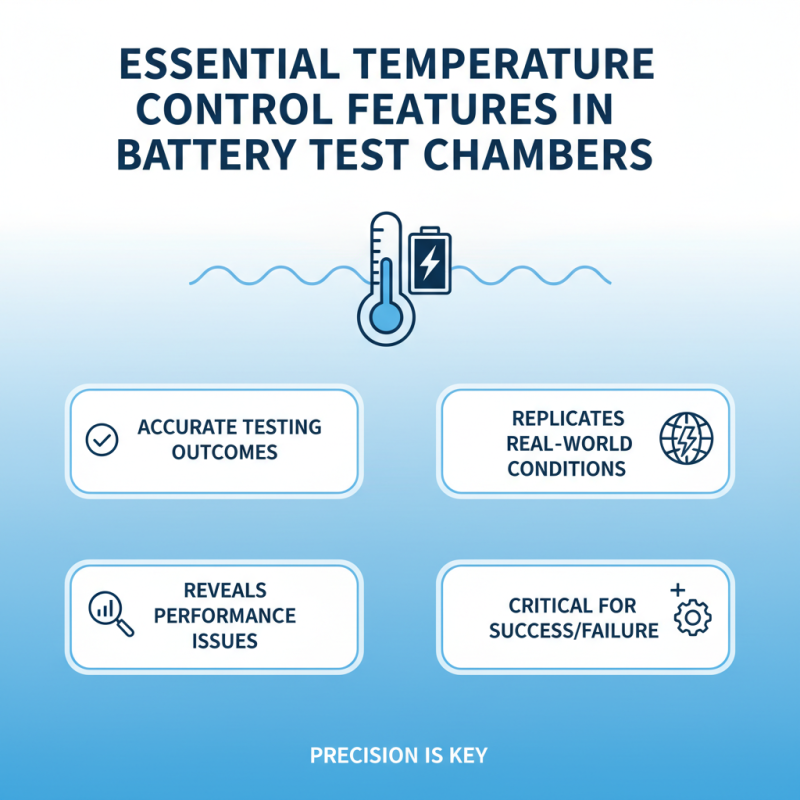
Essential Temperature Control Features in Battery Test Chambers

Top 10 Battery Test Chamber Features You Should Know?

Temperature control is paramount in battery test chambers. Effective temperature regulation ensures accurate testing outcomes. It helps in replicating real-world conditions. Precision in temperature management can reveal performance issues. This aspect can mean the difference between success and failure in battery testing.

Another vital feature is the uniformity of temperature distribution. A well-designed test chamber minimizes temperature gradients. This uniformity leads to reliable data. When batteries are tested at varied temperatures, results can be skewed. It’s essential to maintain consistency throughout the testing process.

Monitoring capabilities also play a crucial role. Real-time data allows for adjustments during tests. This real-time feedback improves reliability. Furthermore, alarms for temperature deviations enhance safety. A chamber that lacks precise monitoring may fall short. Reflections on these features highlight the need for rigorous testing protocols.
Humidity Management Capabilities for Optimal Testing Conditions

Humidity plays a pivotal role in battery testing chambers. One key feature is the ability to control and stabilize humidity levels. Maintaining appropriate humidity can simulate real-world conditions. Battery performance often changes with varying humidity, making it essential to have precise control. Testers can replicate environmental factors effectively, leading to more reliable results.

Monitoring humidity levels should be straightforward. Advanced chambers use sensors for real-time data. Yet, some systems still struggle with consistent readings. It’s frustrating when fluctuations occur, as they can affect test outcomes. Users must regularly check equipment to ensure reliability.

Additionally, fluctuations in humidity can cause condensation issues. This can lead to damage or inaccurate results. Some testers may overlook chamber calibration. This oversight can compromise the integrity of the test. Regular maintenance is key to overcoming these challenges. It’s a reminder that even advanced technology requires careful handling. Better management leads to more accurate and trustworthy testing conditions.

Top 10 Humidity Management Capabilities for Optimal Testing Conditions

Safety Features to Look for in Battery Testing Equipment

When selecting battery testing equipment, safety features are paramount. A comprehensive report by ResearchAndMarkets indicates that battery test chambers should prioritize fire resistance. Lithium-ion batteries can ignite if subjected to extreme conditions. Therefore, a chamber with flame-retardant materials can significantly reduce this risk.

Another critical safety aspect is temperature control. Testing environments must maintain stable temperatures to prevent thermal runaway. According to the National Renewable Energy Laboratory, a variation in temperature can lead to erratic battery performance. A high-quality chamber should incorporate advanced thermal management systems. This ensures consistent conditions during tests.

Tips: Always assess the protective features of the chamber. Look for reinforced enclosures that minimize explosion risks. Regularly review equipment specifications to stay updated on safety standards. Training personnel in emergency procedures is also essential. Consider investing in chambers with integrated monitoring systems for real-time data. These systems can alert staff to hazardous conditions immediately.

Battery testing can involve complexities. Laboratories often face challenges like equipment calibration or environmental interference. Therefore, choosing gear that allows for easy adjustments is beneficial. Make informed choices by considering long-term reliability and overall safety in your operations.

Data Logging and Monitoring Functions for Accurate Results

Data logging and monitoring functions are critical for battery test chambers. Accurate measurement leads to reliable results. In thermal runaway tests, for example, precision can be the difference between success and failure. A study indicates that 80% of battery failures stem from poor data collection practices. Hence, monitoring systems must be robust. They should record voltage, temperature, and current continuously.

Modern chambers often feature integrated software for real-time data visualization. This allows engineers to swiftly identify trends and anomalies. Quick reactions can prevent hazardous situations. Research shows that using advanced data logging can improve test accuracy by 45%. Systems that do not record comprehensive data often fail to provide actionable insights. This can lead to risks and inefficiencies.

Incorporating sophisticated monitoring functions can also facilitate compliance with industry standards. Companies are often required to provide detailed test reports. Those with inadequate data logs may struggle to meet these requirements. Continuous improvement in monitoring technology is essential. However, reliance on faulty data systems can hinder progress and innovation. Investing in quality data management tools is crucial for reliable testing outcomes.

Size and Configuration Options to Suit Various Testing Needs

When choosing a battery test chamber, understanding size and configuration options is vital. Different testing environments require specific chamber sizes. A smaller chamber may suit basic battery tests, while larger setups accommodate extensive research. The configuration can also differ. Some chambers offer vertical setups, while others allow for horizontal testing. This flexibility often helps optimize space in a busy lab.

The ability to customize a chamber’s layout is a significant advantage. Laboratories frequently deal with changing requirements. A flexible configuration allows for modifications without needing a new chamber, saving both time and resources. However, this adaptability may lead to unexpected challenges. Ensuring that all testing conditions remain stable can become complicated.

It's important to consider airflow and temperature distribution within the chamber. Proper design can enhance accuracy but may also invite flaws if not executed well. Balancing size with functionality can sometimes feel like an uphill battle. Plenty of options exist, but finding the right fit is crucial. Users often overlook how configuration impacts their testing needs. A thorough assessment of both size and layout ultimately ensures reliable results.

Top 10 Battery Test Chamber Features You Should Know

Feature Description Benefits Testing Applications
Size Options Various chamber sizes available to accommodate different battery types. Versatility for testing small to large batteries. Consumer electronics, automotive batteries.
Temperature Range Wide temperature range for thermal stress tests. Evaluate performance under extreme conditions. Battery life cycle testing.
Humidity Control Adjustable humidity settings to simulate real-world conditions. Improved accuracy of testing results. Environmental testing.
Safety Features Built-in safety mechanisms such as fire suppression. Enhanced safety during high-risk tests. High-capacity battery testing.
Data Logging Integrated data logging systems for results tracking. Simplifies analysis and reporting. All battery types.
User Interface Intuitive interface for ease of use. Reduces training time for operators. Industry-wide applications.
Modular Design Modular components for customizable setups. Flexibility to adapt to different testing scenarios. Specialized battery research.
Remote Monitoring Remote access and control capabilities. Improved workflow and efficiency. Long-term testing scenarios.
Rapid Testing Fast testing cycles for increased throughput. Accelerates product development. Prototype testing.
Energy Efficiency Low energy consumption design. Reduces operational costs. Sustainability assessments.