


Deepening the Ozone Aging Mechanism: How Test Chambers Simulate Accelerated Material Aging
1. Background
Ozone in the ground atmosphere reacts with polymer materials containing unsaturated bonds, causing surface cracking, hardening, or gloss loss in rubber, coatings, or plastics. To quickly verify a material's ozone resistance, laboratories typically use ozone aging chambers. By increasing ozone concentration, controlling temperature and humidity, and applying mechanical strain, they compress the natural aging process to days or weeks.
2. Chemical Pathways of Ozone Aging
Ozone Exposure: Ozone molecules first adsorb on the material surface.
Electrophilic Addition: Ozone reacts with carbon-carbon double bonds to form unstable primary ozonides.
Pyrolysis and Free Radical Chain Reactions: Ozone decomposes to produce aldehydes, ketones, and free radicals, which then attack the polymer backbone, causing chain scission or crosslinking.
Macroscopic Manifestations: Microscopic cracks expand into visible cracks, resulting in a decrease in mechanical properties or loss of surface gloss.
3. How a Test Chamber Accelerates Ozone Resistance
Increasing Ozone Partial Pressure: The test chamber elevates ozone concentrations far above natural ambient levels, significantly increasing the number of ozone molecules impacting the material surface per unit time.
Temperature Control
Appropriate temperature increases can accelerate ozone diffusion and reaction rates, but the upper temperature limit is generally set near the material's actual operating temperature to minimize interference from thermal oxidative aging.
Humidity Control
Moisture alters the dissolution and diffusion behavior of ozone on the material surface; the test chamber uses a humidification unit to simulate wet or dry conditions.
Mechanical Strain
Cracks typically initiate at points of tensile stress concentration. Static tensile or dynamic reciprocating modes maintain a certain degree of deformation in the material, facilitating observation and recording of the crack initiation process.
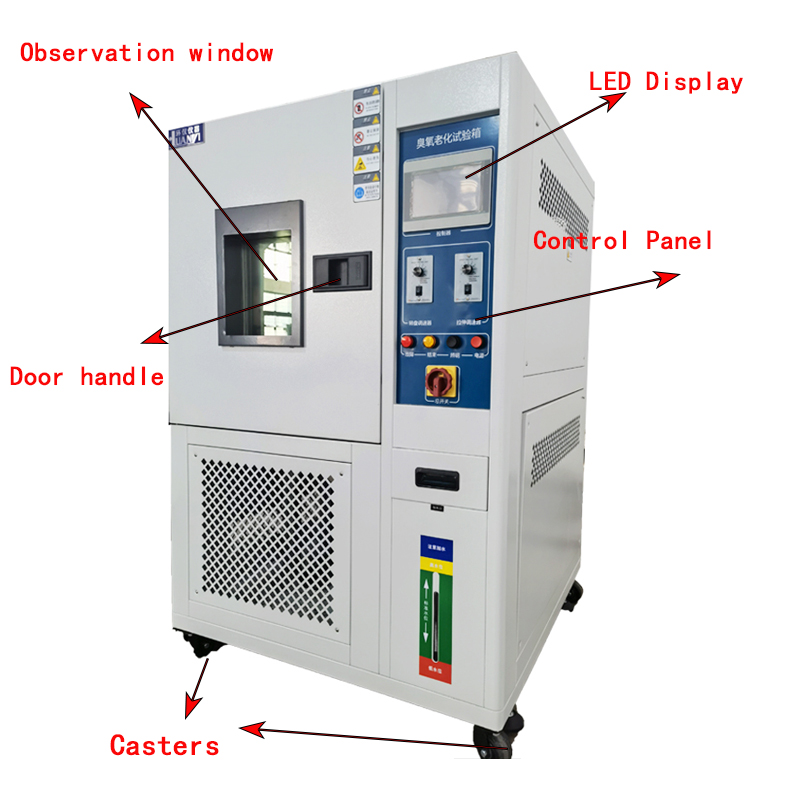
4. Internal Chamber Process
Gas Preparation: Filtered dry air or oxygen is fed into the ozone generator after being stabilized by a flow valve.
Ozone Generation: Silent discharge or ultraviolet irradiation converts some oxygen molecules into ozone.
Uniform Mixing: A circulating fan distributes ozone-containing air evenly into the chamber, avoiding dead zones.
Environmental Maintenance: Temperature and humidity sensors provide real-time feedback, and the controller implements closed-loop regulation through the heating, cooling, and humidification units. Real-time Monitoring: A UV photometer or electrochemical probe continuously monitors ozone concentration. If the ozone concentration exceeds the specified level, the discharge power is reduced; if it falls below the specified level, the power is increased.
Safe Discharge: After the test, residual ozone is adsorbed by a catalytic decomposer or activated carbon until it is reduced to a safe level before unpacking.
5. Correlation of Results with Engineering
The test records the time of crack onset, crack density, and mechanical property retention. By comparing these results with outdoor exposure or service data, empirical acceleration factors can be established, providing a reference for material life assessment or formulation improvement.
For further discussion on Ozone Aging Test Chamber selection, program setup, or result interpretation, please contact us.