










Portable Outdoor Power Supply IPX3 Rainproof Adaptability Assessment Solution
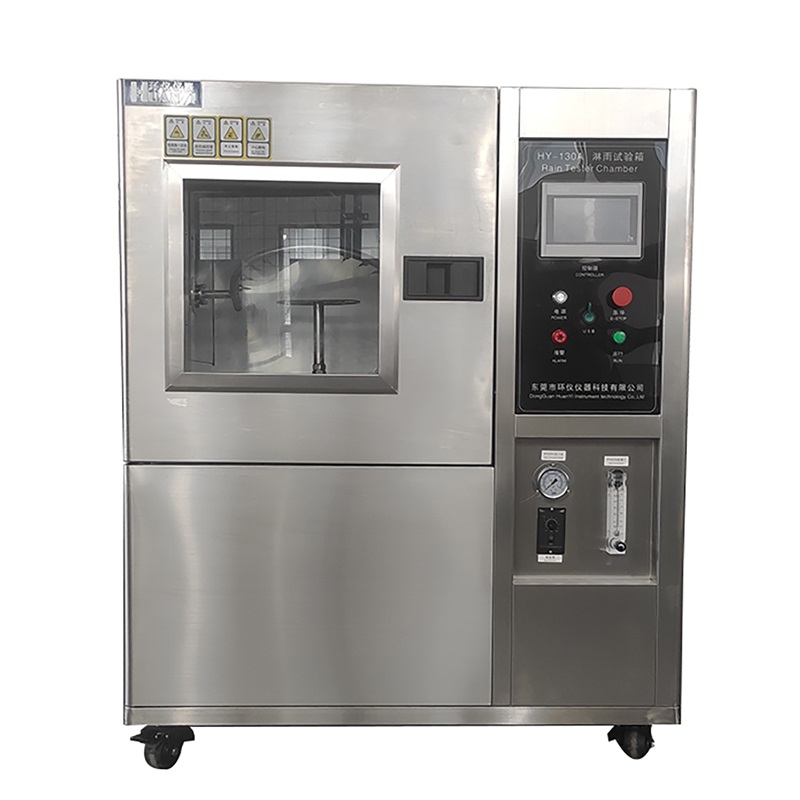
The rain test apparatus belongs to the IPX3 and IPX4 levels of IP protection equipment and is mainly used to test the waterproof performance of the outer shells of automotive lights, windshield wipers, electronic products and containers.
1. Solution Overview
With the increasing popularity of camping and road trips, the application scenarios for portable outdoor power supplies are becoming increasingly diverse. This solution utilizes a platform-style spray system in a Rain Test Chamber to simulate rain conditions at angles up to 60° to the vertical, evaluating the power supply's adaptability to brief exposure to light rain or placement on the edge of a tent (where it is sheltered but not completely waterproof).
2. Test Objective
The test focuses on evaluating the waterproof performance of the power supply's ventilation and heat dissipation vents, AC/DC output interface panel, and the assembly points between the display screen and the casing under inclined rain conditions, preventing short circuits or performance degradation caused by minor water ingress.
3. Test Equipment and Conditions
Core Equipment: Rain Test Chamber (IPX3 rated platform-style or oscillating spray system).
Water Flow Rate: 0.07 L/min × number of nozzles (or total flow rate calculated according to standards).
Test Angle: The sample platform can be tilted, allowing the sample to be exposed to rain within a range of 0° to 60° relative to the vertical. Typically, four tilt directions are tested (front, back, left, and right).
Test Duration: Continuous rain exposure for 2.5 minutes in each tilt direction, with a total duration of at least 10 minutes.
4. Test Procedure
Installation and Tilt: Place the outdoor power supply normally on the sample platform of the rain test chamber. Following the protocol, adjust the angle of the sample platform sequentially, tilting it 60° to face each of the four main directions.
Zoned Testing: At each tilt angle, activate the water spray system, allowing water to fall vertically from above for 2.5 minutes. This means different surfaces of the sample will be tested under different tilt positions.
Inspection: After all tests are completed, carefully dry the exterior, allow it to stand for a short time, and then open the chamber for inspection. A load test must be performed to verify that the output voltage and current are normal.
5. Result Judgment
If the internal circuit board, battery pack, and other core components remain dry with no signs of moisture intrusion, and all output functions of the power supply are stable, it indicates that the outdoor power supply has a certain degree of rain resistance and meets the IPX3 protection requirement, providing users with added protection in varying outdoor environments.