




Research on Anti-explosion of Environmental Testing Equipment
Environmental test equipment mainly simulates a series of natural conditions such as high temperature, low temperature, humidity, infrared radiation, low pressure, dust and mold, and has high requirements for simulation accuracy. With the development of the industry, more and more customers need to realize the above environmental simulation while putting forward explosion-proof requirements for equipment to adapt to a wider range of test samples. Explosion-proof should first consider the ability to detect the concentration of flammable gas in the box during the simulation test. When an abnormality is found, the test box should take measures to reduce the concentration of flammable gas to avoid accidents such as combustion and explosion; once an explosion occurs, the strength structure and protective measures of the test box are particularly important. Proper protection can reduce economic and property losses and avoid casualties.
1 Control of high and low temperature and humidity test explosion-proof box
Explosions are caused by violent chemical reactions such as combustion. In order to prevent the combustion reaction of samples in the high and low temperature and humidity test box during the test, when a small amount of flammable gas is generated in the box, the control of the high and low temperature and humidity test box can be designed to introduce fresh air action in the control of the high and low temperature and humidity test box, and the concentration of flammable gas in the box can be kept within a safe range by introducing fresh air from the outside. In case of serious situations such as open fire and explosion in the box, the temperature in the box will rise sharply. At this time, the fire extinguishing action should be designed in the control of the test box to control and extinguish the fire in the test box in time to prevent the open fire and explosion from spreading outside the test box to avoid causing damage to surrounding equipment, property and casualties.
2 Electrical design of high and low temperature and humidity test explosion-proof box
In order to realize the explosion-proof early warning detection of the high and low temperature and humidity test box, control the concentration of flammable gas in the test box and automatically extinguish the fire after combustion and explosion, some special designs are required in the electrical aspect.
2.1 Combustible gas sensor
At the front end of the high and low temperature and humidity test box (such as the position below the door), a combustible gas concentration detection sensor is installed. The sensor adopts a pump suction structure to sample and absorb the gas in the box from the test box for detection. The sampling port is installed at the outlet of the circulating air in the box. The combustible gas sensor panel can set and display two alarm points. When the combustible gas concentration detected in the box exceeds the set alarm point, the combustible gas sensor gives a warning or danger alarm signal; and outputs the corresponding circuit-breaking signal through the built-in output terminal. After the system PLC detects that the corresponding DI input signal is disconnected, it makes the corresponding DO output action, thereby controlling the start of safety protection devices such as ventilation devices and CO2 fire extinguishing systems.
2.2 Heater
In order to avoid open flames, ordinary nickel-chromium wire heaters cannot be used in explosion-proof boxes. Fin-type armored electric heaters must be used, and the armored tubes and fins are made of stainless steel. This packaged heater will neither produce open flames nor cause secondary faults such as short circuits due to external forces such as explosions.
2.3 Ventilation damper
Ventilation fans, ventilation valves and dampers are installed on both sides of the door body, and are connected to the box through a Φ100 air duct. A check valve plate is provided at the connection with the test box wall. When there is no air exchange, there is no gas exchange between the box and the outside world. The ventilation valve and ventilation fan are installed on the outside of the test box body and are equipped with a protective cover. The ventilation volume of the ventilation fan shall not be less than 5m/min.
2.4 Automatic injection CO2 fire fighting device
When a fire or explosion occurs, the temperature in the high and low Temperature Humidity Test chamber will rise sharply. This abnormal temperature change can be detected by a dedicated temperature sensor, and the abnormal temperature signal is transmitted to the test chamber control system. The system sprays CO2 by opening the electric valve.
2.5 Temperature abnormality detection
Equipped with 2 temperature sensors that can be moved to any position in the chamber to detect the surface temperature of the sample. When the surface temperature of the sample is abnormal and higher than the preset temperature, the red alarm light of the equipment and the high temperature light in the chamber light up at the same time, and the equipment stops running and cuts off the power supply of the sample through the test power terminal.
2.6 Emergency stop switch
When the operator finds an abnormality in the chamber, he immediately presses the emergency stop switch, the equipment stops the operation of the chamber, and cuts off the secondary power supply of the test chamber through the AC contactor, but the safety system (ventilation, CO2 injection, etc.) is not affected and works normally.
2.7 Safety operation device display panel
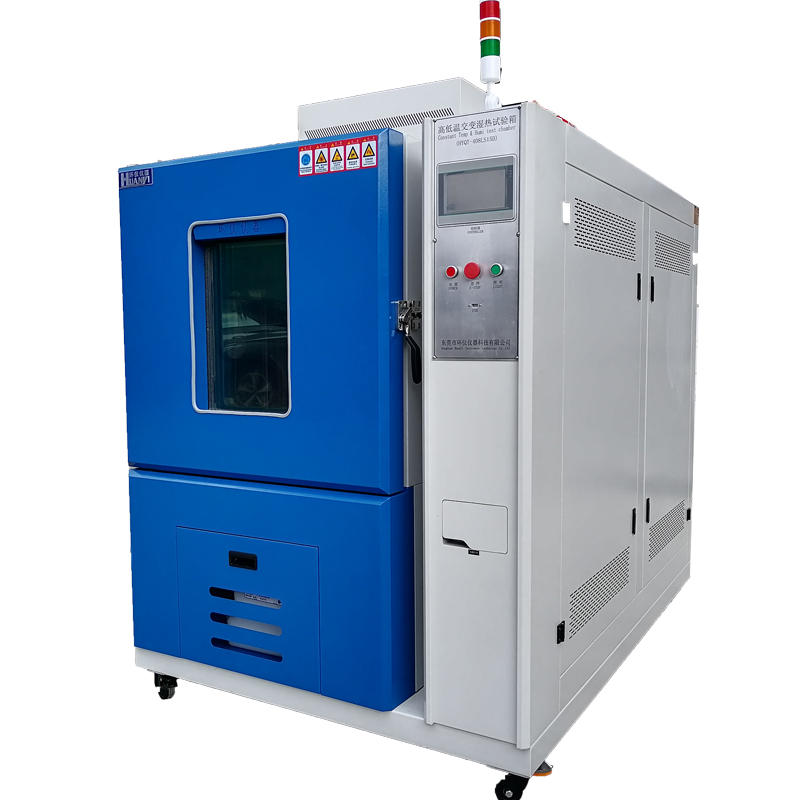
Installed at the most easily operated position of the equipment, i.e., on the right side of the front of the box. The ventilation device switch, CO2 fire-fighting device manual-automatic switch, emergency stop switch, gas alarm light, and abnormal temperature display light in the box are all installed here.
2.8 UPS uninterruptible power supply
Used to supply power to the gas alarm circuit, ventilation device, CO2 fire-fighting device, temperature indication alarm circuit and safety device operation display panel when the power is off or the leakage circuit breaker and automatic circuit breaker of the test box are actuated, so as to ensure the normal operation of the safety system in the event of a power outage or explosion.
2.9 Three-color alarm light
Installed at the most conspicuous position on the top of the equipment.
3 High and low temperature and humidity test explosion-proof box structure
3.1 Box reinforcement
The outer side of the box is reinforced with 100mm channel steel to prevent the box of the test box from being severely deformed and damaged by a huge impact when an explosion occurs, the fire spreads, and hard objects are ejected to cause accidental injuries. The cover is designed in small blocks to avoid the channel steel position, which is convenient for disassembly and assembly, and daily maintenance of the test box.
3.2 Safety protection door
In addition to the door with an observation window on the test box, a reinforced safety protection door should be installed. Be careful not to block the controller and observation window of the test box. The protection door is also equipped with a limit switch for door opening detection. When the safety protection door is open, the equipment box stops running; the test box can only be operated when the protection door is closed and the limit switch is in the closed state.
3.3 Pressure relief valve
The pressure relief valve needs to release pressure toward the top of the box, and not toward the lateral side or bottom of the box to prevent injury. The pressure relief valve operates when the internal pressure in the box rises sharply to release the pressure in the box. There must be a metal protective mesh cover outside the pressure relief valve. The expansion and release of the explosion gas in the mesh cover can reduce the impact of the explosion on the outside.
3.4 Observation window
The design size of the observation window should not be too large, and a round shape is preferred. The outer ring and the test chamber door can be fixed with double-layer stainless steel fixings. The glass material should be tempered explosion-proof glass, and a protective mesh cover should be installed on the outside of the glass for protection to prevent glass fragments from injuring people in case of explosion.
3.5 Lead hole
In addition to the insulation rubber plug, the lead hole should also be equipped with a threaded protective screw cap, with a small hole drilled on the screw cap and a pre-buried sheath pipe for threading. When the pressure in the box rises sharply, the screw cap can prevent the rubber plug from shooting out and injuring people.
3.6 Installation site
In order to avoid the pressure rise around the test chamber when the high and low Temperature And Humidity Test Chamber is depressurized, the installation site of the test chamber should be spacious and there should be no obstacles around the test chamber. In order to prevent the fire in the test chamber caused by the depressurization and cause secondary losses, a certain distance should be left between the top of the test chamber and the roof of the test chamber, and the roof should be a fireproof steel-concrete structure; if a suspended ceiling is installed, flame-retardant materials should be used.
4 Conclusion
The explosion-proof function of the high and low temperature humidity test chamber meets the needs of the electronics, military and other industries.