



Tensile Testing Machine: Principle, Structure and Key Technology Analysis
Principle
The Computerized Tensile Testing Machine is based on mechanical principles and applies tension or pressure to the specimen through a driving system. Force sensors (mostly strain gauges or piezoelectric) sense the force on the specimen and convert the force into electrical signals. This signal is amplified by an amplifier, converted into a digital signal by an analog-to-digital converter, and then processed and displayed by a computer. At the same time, displacement sensors (such as grating rulers and encoders) accurately measure the displacement of the moving crossbeam, indirectly obtaining the deformation of the sample. The signal is also processed and analyzed together with the force value signal to obtain mechanical performance parameters such as elastic modulus and yield strength.
Structure
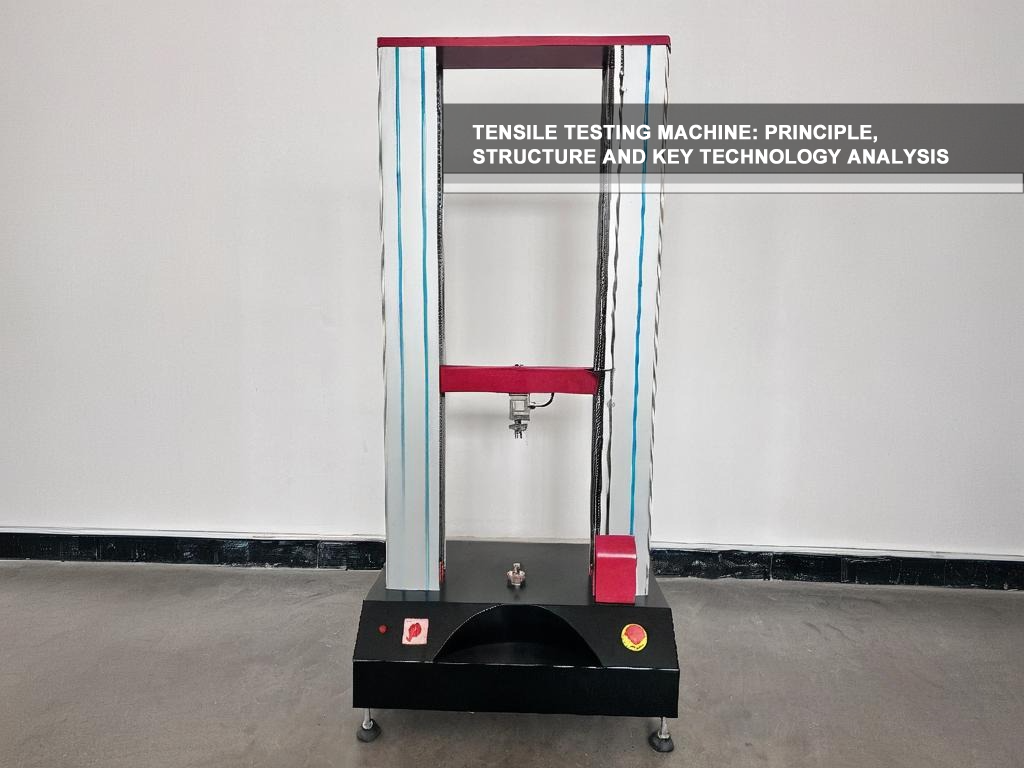
The testing machine consists of a mechanical part, a data acquisition part, a servo drive part, a data processing part, etc. The mechanical part includes the main frame, drive system, and fixture. The main frame provides stable support, while the drive system (motor, reducer, screw, etc.) drives the moving crossbeam to move up and down. The fixture is used to firmly clamp the sample. The data acquisition part is responsible for real-time collection of force values and displacement signals, the servo drive part controls the operation of the drive system, and the data processing part analyzes and calculates the collected data.
Key technologies
High precision measurement technology: using high-precision force sensors and displacement sensors to ensure the accuracy of measurement results.
Full digital speed control system and precision reducer: achieve large-scale adjustment of test speed, with low noise and smooth operation during the test process.
Intelligent control system: equipped with touch keys and LCD display, easy and fast operation, with multiple protection mechanisms such as limit protection, overload protection, power failure memory, etc. The automatic return function reduces manual intervention and improves test efficiency.
Data processing and analysis technology: Computers collect signals in real time through data acquisition cards, calculate various mechanical performance parameters, draw force displacement curves, stress-strain curves, etc., and visually display the mechanical properties of materials.