



What's a vacuum oven for?
Vacuum Drying Ovens are essential tools for drying, curing, and heat-treating processes under reduced pressure in both laboratory and industrial environments. Vacuum drying ovens are extremely important due to their widespread applications in various fields, including materials science, pharmaceuticals, and electronics. They enable the gentle and controlled removal of moisture or volatile substances from sensitive samples without subjecting them to high temperatures or oxidizing conditions.
This discussion of vacuum drying ovens provides a deeper understanding of their principles, functions, and developments, which can help improve product quality, stability, and production efficiency. Vacuum drying ovens are crucial for researchers, engineers, and manufacturers seeking reliable and precise methods for low-temperature drying and processing of sensitive materials.
What are vacuum ovens used for?
A Vacuum Oven, also known as a vacuum drying oven, primarily utilizes vacuum and heat to accelerate the drying process. As pressure decreases, the boiling point of solvents also decreases, enabling vacuum ovens to remove moisture and volatile substances at lower temperatures. Furthermore, because the air is removed from the vacuum oven, heat transfer within the oven is more efficient. By reducing oxygen (O2) and moisture levels, drying efficiency is improved while the risk of oxidation and explosion is reduced. Some vacuum ovens can even be equipped with inert gases such as nitrogen (N2) or helium (He) to prevent oxidation, corrosion, or scaling.
The advantages of vacuum ovens can be summarized as follows:
· Lowers the boiling point of solvents, thereby reducing heating temperatures. Suitable for processing heat-sensitive and volatile materials.
· Minimizes oxidation, making it suitable for processing flammable and explosive materials.
· Improves drying efficiency by improving heat transfer and removing oxygen and moisture.
Vacuum Oven Applications
The most common vacuum oven applications include:
· Dehumidification:
One of the primary functions of a vacuum oven is to remove moisture from devices or pharmaceuticals, especially when processing fragile or temperature-sensitive items such as microchips and pharmaceuticals. Porous objects are particularly susceptible to moisture trapping in their pores, leading to product damage and failure. Vacuum ovens can effectively and gently remove moisture, thus preventing such product failure.
· Degassing:
Sealants and lubricants used in certain metal parts often release moisture or chemical vapors. These residues can cause product or electronic component failure. Vacuum ovens play a vital role in removing moisture and chemical residues, a process known as degassing or degassing, as described in ASTM E595, the standard for degassing in vacuum environments.
· Preventing Oxidation:
By controlling the temperature and vacuum level, vacuum ovens can effectively prevent oxidation, corrosion, and scaling. This feature is particularly important in the pharmaceutical industry, where oxidation can affect product quality.
· Baking and Degassing:
Baking involves raising the temperature within the vacuum oven to force volatile chemicals out of the processed objects. Because oxidation reactions are effectively controlled within the vacuum oven, these chemicals can be removed more safely and efficiently. Baking also serves to degas, as heated liquids release gases in the form of bubbles that can be captured and removed by the vacuum system.
For these reasons, vacuum ovens are widely used in various industries, including electronics, semiconductors, aerospace, and pharmaceuticals. Furthermore, vacuum ovens can dry objects at relatively low temperatures, making them important in the food industry, where high temperatures can lead to the loss of nutrients or spoilage. For more information on drying methods, refer to CNS 5033, "Test Methods for Moisture in Foods."
Objects Treated with Vacuum Ovens
Vacuum ovens, with their ability to dry at lower temperatures, are suitable for processing the following:
Heat-sensitive materials: These include fruits and vegetables, enzymes, microorganisms, antibiotics, and other sensitive substances that may degrade or lose their effectiveness at higher temperatures.
Difficult-to-dry materials: Vacuum ovens are effective for drying powdered or granular materials that may clump or form lumps using traditional drying methods.
Flammable and explosive materials: While extreme caution is required when handling flammable and explosive materials, vacuum drying ovens can be used to dry such materials. However, it is crucial to select a vacuum drying oven that is explosion-proof certified, such as those compliant with ATEX, IECEx, or Hazloc standards, to ensure safety during the drying process.
Comparison of Vacuum Ovens, High-Temperature Ovens, and Microwave Dryers
High-temperature ovens heat objects at atmospheric pressure. Fans are typically used to circulate heated air within the oven chamber to facilitate the drying process.
In contrast, microwave dryers differ primarily from vacuum dryers in their heating principle. They use microwave radiation to generate heat in a vacuum environment. While their application range may overlap with vacuum drying, the appropriate drying method should be selected based on the specific characteristics of the sample.
| Drying device | Vacuum oven | Hi-temp oven | Microwave dryer |
| Heat generation | Heat convection/Heat radiation | Heat convection | Microwave radiation |
| Heating principle | Vacuum lowers liquid boiling point and accelerate evaporation | Heat with fan circulation | Vacuum lowers liquid boiling point and accelerate evaporation |
| Heating temperature | Low | High | Low |
| Heating efficiency | High | Lower | Very high |
| Appropriate for substances | Heat sensitive substances Easily-oxidized substances Difficult-to-dry substances Flammable/explosive substances Light-weighted substances | General substances | Heat sensitive substances Easily oxidized samples Decomposable samples Light weight sample |
| Applications | Chemistry, biology, medicine, precision materials, food, aerospace | Food, agriculture, environment | Food (mainly), chemistry, biology, medicine |
Setting Up and Installing a Vacuum Oven
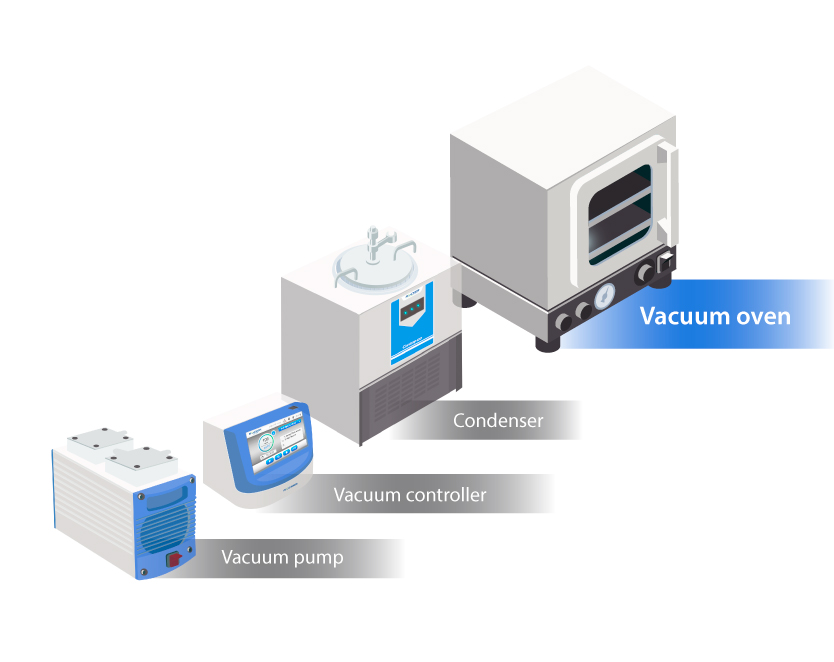
A vacuum oven is typically equipped with a vacuum pump to achieve the required vacuum level within its chamber, along with several other devices depending on the application.
1. Vacuum Controller
To prevent oxidation and deterioration of the target object, more precise and stable vacuum control is crucial. A vacuum controller with linear control can gradually reduce the pressure, avoiding sudden changes in airflow within the chamber. This feature is particularly important when drying lightweight objects such as powders or feathers.
2. Condenser
The condenser is installed between the vacuum oven and the pump (or controller). Because vacuum ovens are primarily used for drying, the evaporated gases often contain significant amounts of water or solvent vapor. The condenser plays a crucial role in effectively recovering the vapors and preventing harmful gases from escaping into the environment. It also prevents vapor and hot air from entering the pump or controller.
3. Vacuum Pump
Select a pump flow rate based on the amount of vapor produced; a flow rate of twice the oven volume is generally recommended. If the dried object is heat-sensitive or contains liquids with high boiling points, a pump capable of generating a higher or deeper vacuum is recommended. For user safety and equipment life, select a chemically resistant pump if the dried object contains corrosive materials (such as lithium batteries). The following provides a quick guide to pump selection.