Leave Your Message

Top 10 Altitude Test Chamber Benefits for Global Buyers?

The Altitude Test Chamber market has witnessed significant growth in recent years, driven by increasing demand for product resilience in extreme conditions. According to a report by MarketsandMarkets, the global altitude test environment market is projected to reach $600 million by 2025. This growth is fueled by industries such as aerospace, automotive, and electronics, where performance at high altitudes is critical.

Dr. Emily Transon, a leading expert in environmental testing, asserts, "Altitude Test Chambers provide invaluable insights into a product’s durability under extreme conditions." Her statement highlights the necessity of rigorous testing for ensuring the reliability of sophisticated technology. These chambers not only simulate high-altitude environments but also subject products to extreme temperatures and humidity, allowing manufacturers to identify potential failures early.

However, despite the clear benefits, many companies still overlook the importance of altitude testing. Some believe it is an unnecessary step in their product development process. Yet, ignoring these tests can lead to costly failures in the field. As industries evolve, embracing the advantages of Altitude Test Chambers is essential for any company aiming to thrive in a competitive market.

Top 10 Altitude Test Chamber Benefits for Global Buyers?

Advantages of Using Altitude Test Chambers for Global Buyers

Altitude test chambers offer significant advantages for global buyers focused on product reliability. They simulate high-altitude conditions, enabling manufacturers to evaluate how products perform in extreme environments. These chambers help in identifying potential failures early. This early detection is crucial for enhancing product reliability and reducing long-term costs.

One key benefit is improving product durability. By subjecting items to simulated high-altitude stresses, manufacturers can refine designs before launching. However, it's essential to note that not all products respond the same way to extreme testing. Some items might fail under unexpected conditions. Global buyers must pay attention to the specific requirements of their products.

Testing in altitude chambers also aids in compliance with international standards. This compliance can open up global markets. However, navigating these standards can be complex. Buyers need to be meticulous when interpreting requirements to ensure proper testing. Collaborating with experts in the field can provide unique insights that enhance testing strategies.

Tips: Always review testing protocols carefully. Ensure they align with your specific product needs. Regularly update your testing methods based on new findings. This step can significantly improve reliability and performance.

Key Features of Altitude Test Chambers That Enhance Product Testing

Top 10 Altitude Test Chamber Benefits for Global Buyers?

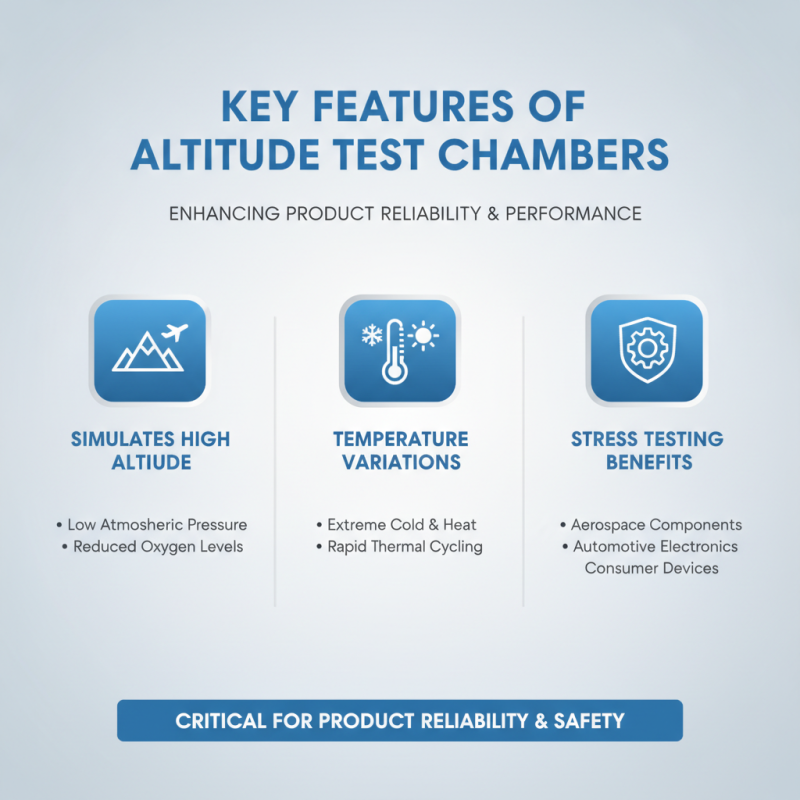
Altitude test chambers are vital for product reliability testing. These chambers simulate high-altitude conditions, revealing how products perform under stress. Products are exposed to low pressure and temperature variations during testing. This process is critical for aerospace, automotive, and electronics industries.

Key features include adjustable altitude levels. Users can set specific elevations for precise testing. Furthermore, the chambers have advanced thermal management systems. These systems ensure uniform temperature distribution. This prevents hotspots and provides accurate results. The ability to rapidly change conditions also helps in observing product behavior efficiently.

Another essential aspect is data collection capabilities. Test chambers often come with software that tracks and logs results. This data is crucial for improving product design and ensuring compliance with industry standards. Despite these benefits, not all chambers offer the same level of precision or reliability. Buyers must carefully evaluate specifications before making decisions. Quality assurance in testing equipment directly impacts outcomes.

Cost-Effectiveness of Altitude Test Chambers in Development Processes

Altitude test chambers serve as essential tools in the development processes of various industries. They simulate high-altitude conditions, effectively testing products under reduced pressure and low oxygen levels. This leads to valuable insights during product development, enhancing reliability and performance. The cost-effectiveness of such chambers is evident. Companies can save on prolonged testing phases and avoid costly design flaws.

Investing in altitude test chambers minimizes risks in the long run. The initial expense may seem high, but the reduction in failure rates justifies the cost. Companies often face setbacks without proper testing. These chambers enable engineers to conduct multiple experiments without outside interference. However, some manufacturers may overlook the importance of consistent testing, which can lead to product recalls.

Choosing the right altitude test chamber can be challenging. It requires expertise to identify suitable options based on specific product needs. Often, teams may not fully understand the chamber's capabilities. This can result in underutilization. Companies must reflect on their needs and the benefits that altitude test chambers can offer. Balancing quality, expense, and testing frequency is crucial for optimal results.

Impact of Altitude Testing on Product Quality and Compliance Standards

Altitude testing is critical in evaluating product resilience. It simulates high-altitude conditions, enabling manufacturers to identify how products perform under pressure. This testing reveals potential weaknesses that could compromise quality and safety. When products fail to meet these standards, risks to consumers increase significantly.

Proper altitude testing assures compliance with industry regulations. It quantifies how environmental conditions impact product integrity. In sectors like aerospace and electronics, these tests are non-negotiable. They help manufacturers ensure that products can endure various atmospheric conditions. However, many companies overlook this testing, assuming their products will perform adequately. This oversight could lead to costly failures and recalls.

Investing in altitude testing can elevate product quality. It builds consumer trust and enhances marketability. Yet, not all companies approach altitude testing with the necessary seriousness. Some view it as an expense rather than an investment. Without thorough testing, businesses may find themselves exposed to liability issues. Understanding the importance of altitude testing is essential for producing reliable, high-quality products.

Top 10 Altitude Test Chamber Benefits for Global Buyers

Benefit Description Impact on Quality Compliance Standards
Improved Product Reliability Simulates high-altitude conditions to test durability. Ensures products withstand extreme conditions. ASTM D7850, MIL-STD-810
Enhanced Safety Identifies potential failures before products hit the market. Reduces risks of product recalls. ISO 9001
Cost Efficiency Early detection of defects decreases long-term costs. Regular maintenance reduces unexpected failures. ISO 14001
Quality Assurance Confirms products meet specified performance standards. Increases customer satisfaction and trust. CE Marking, RoHS
Market Readiness Accelerates product development timelines. Provides faster time-to-market for new products. FDA, FCC
Data Accuracy Provides reliable test data for evaluation. Enables better decision making regarding product design. ISO/IEC 17025
Environmental Impact Testing Assesses environmental impact on product lifespan. Supports sustainable product development. ISO 14040
Competitive Advantage Validated quality can differentiate products in the market. Enhances brand reputation and market positioning. Various industry-specific standards
Regulatory Compliance Assists in meeting local and international regulations. Avoids legal issues and penalties. Various regulatory bodies
Innovation Support Facilitates the development of advanced technologies. Encourages research and development in product design. Industry innovation standards

Future Trends in Altitude Testing Technologies for Buyers Worldwide

Top 10 Altitude Test Chamber Benefits for Global Buyers?

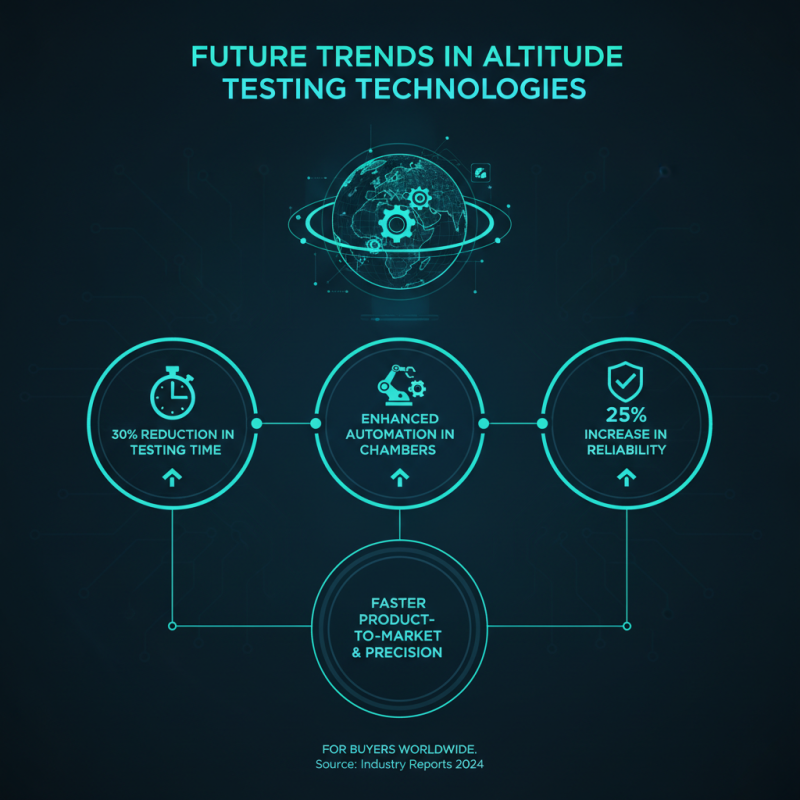
Altitude testing technologies are evolving rapidly to meet global demands. In recent reports, the reduction in testing time by up to 30% was highlighted as a key benefit. This advancement allows companies to bring products to market faster. Enhanced automation in altitude chambers is another trend, with automated systems improving consistency. An estimated 25% increase in reliability is noted, leading to more precise testing results.

Virtual simulations are becoming popular. They provide a cost-effective and flexible way to test product performance in various altitude conditions. Combining physical testing with virtual environments can enhance predictive accuracy. This dual approach decreases the need for multiple physical prototypes. However, it may also require skilled personnel who can interpret complex data.

Tip: Ensure your team understands both testing methods. Training is essential for maximizing the benefits of these technologies. Embrace data analytics to improve testing strategies continuously. Balancing between traditional and modern techniques can yield the best outcomes. In a fluctuating market, keeping pace with these trends is crucial for success.