- Home
- Products
- About Us
- Resources
- Support
- Blog
- Contact Us
Leave Your Message
-
Phone
-
E-mail
-
Whatsapp
-
WeChat


Choosing the right Climate Chamber in 2026 requires more than comparing temperature ranges and catalog photographs. Global buyers are evaluating reliability, energy use, control accuracy, validation support, and long-term service. A chamber used for battery testing may need rapid temperature changes. A pharmaceutical laboratory may prioritize humidity stability and documented performance. Food, electronics, automotive, and materials testing each demand different operating conditions.
The market now includes temperature chambers, humidity chambers, walk-in chambers, thermal shock chambers, altitude chambers, and specialized light or corrosion systems. Each type solves a different testing problem. Details matter. Door design, sensor placement, airflow, noise, chamber volume, and recovery time can affect daily results. In practical evaluations, a larger model is not automatically better. It may consume more energy and create uneven conditions when lightly loaded.
Reliable purchasing also depends on evidence. Buyers should review calibration records, factory testing procedures, safety features, warranty terms, and regional technical support. Recognized standards can guide evaluation, but compliance claims still require careful verification. A polished brochure is not proof. Ask for test data under realistic loading, not only empty-chamber performance.
This guide examines the leading Climate Chamber types for global buyers in 2026. It connects chamber design with real laboratory needs, installation limits, and ownership costs. No chamber is perfect. A supplier may offer excellent controls but limited local service. An economical unit may later require expensive upgrades. That uncomfortable gap deserves attention before purchase, because dependable environmental testing begins with realistic requirements, not impressive specifications.
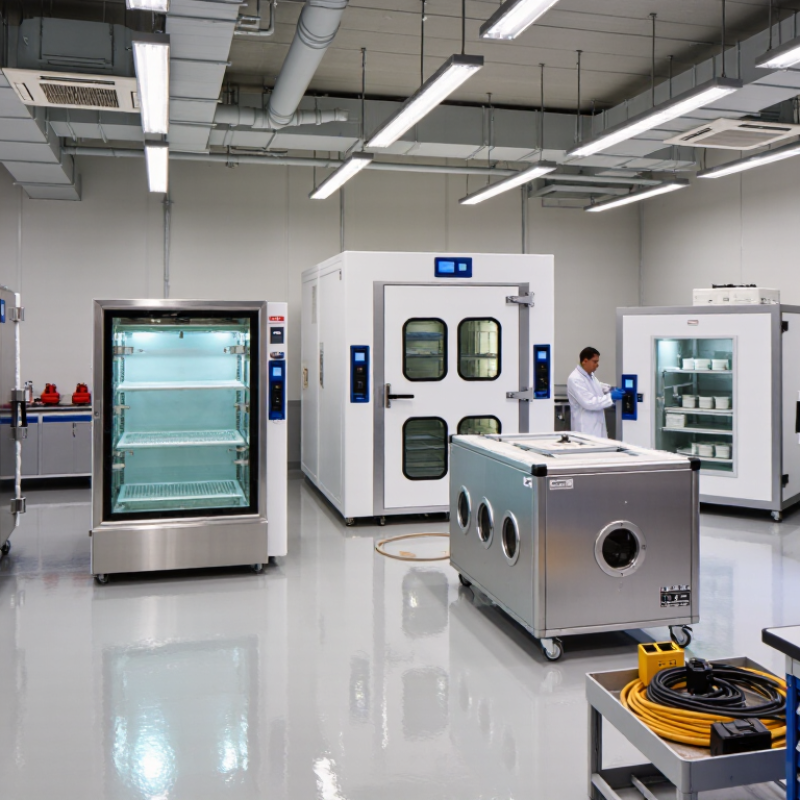
2026 Top Climate Chamber Types for Global Buyers
Climate Chambers: Definition, Purpose, and Core Classification
A climate chamber is an enclosed test system that controls temperature, humidity, light, or other environmental conditions. It helps engineers observe how products behave before field deployment. A chamber may hold a small circuit board, a battery module, or a full packaging assembly. Inside, sensors record changes while programmed conditions run for hours or weeks.
The core classification depends on the stress being controlled. Temperature chambers create stable cold or heat. Humidity chambers add moisture to reveal corrosion, swelling, insulation failure, or material distortion. Thermal shock chambers move specimens rapidly between hot and cold zones. Photostability and weathering chambers combine light, heat, and moisture. Altitude chambers reduce air pressure, while combined-environment systems apply several stresses together.
Selection should follow the product’s real risk profile, not a catalogue label. Check temperature range, humidity control, recovery speed, chamber volume, airflow, and sensor accuracy. A door opening can disturb conditions quickly. That detail matters. Experienced test teams also review calibration records, uniformity maps, alarm functions, and data logging before testing. Classification is not always neat; a chamber may serve several purposes with different fixtures and control programs. I have seen tests become unreliable when the specimen blocks airflow or the load differs from validation conditions. That mistake is easy to overlook. Clear test objectives and documented acceptance criteria make results more defensible for global engineering and quality decisions.
| Climate Chamber Type | Definition and Core Purpose | Typical Operating Capability* | Main Applications | Key Controlled Variables | Typical Test Profile | Commonly Referenced Standards or Guidelines |
|---|---|---|---|---|---|---|
| Temperature Test Chamber | A chamber designed to expose products or materials to controlled hot and cold conditions without intentionally controlling relative humidity. | Approximately -70°C to +180°C, depending on chamber design and load. | Electronics, batteries, plastics, automotive components, aerospace parts, packaging, and general material screening. | Air temperature, ramp rate, test duration, specimen load, and recovery time. | Cold exposure, hot exposure, temperature cycling, or storage at a specified temperature. | IEC 60068-2-1 (cold); IEC 60068-2-2 (dry heat); ISO 16750-4 (climatic loads for road vehicles). |
| Temperature and Humidity Chamber | A chamber that independently or jointly controls temperature and relative humidity to reproduce humid, dry, and changing environmental conditions. | Approximately -40°C to +150°C; humidity commonly controlled from about 10% to 95% RH over a defined temperature range. | Reliability testing, corrosion-risk evaluation, pharmaceuticals, medical devices, electronics, food packaging, and automotive systems. | Temperature, relative humidity, dew point, ramp rate, condensation, and dwell time. | Constant damp heat, cyclic damp heat, humidity cycling, or combined temperature-humidity exposure. | IEC 60068-2-30 (damp heat, cyclic); IEC 60068-2-78 (damp heat, steady state); ASTM D4332; ISO 16750-4. |
| Stability Test Chamber | A precisely controlled temperature-and-humidity chamber used to assess how products maintain quality, safety, and performance over time. | Common pharmaceutical conditions include 25°C/60% RH, 30°C/65% RH, and 40°C/75% RH; exact conditions depend on the product and protocol. | Pharmaceuticals, biologics, cosmetics, healthcare products, chemicals, food ingredients, and packaging systems. | Temperature uniformity, humidity uniformity, alarm limits, mapping, monitoring, and long-term data recording. | Long-term, intermediate, accelerated, or stress stability studies using predefined time points. | ICH Q1A(R2) stability testing; WHO stability guidance; applicable regional pharmaceutical regulations. |
| Thermal Shock Chamber | A system that rapidly transfers specimens between hot and cold zones, creating severe temperature transitions in a short time. | Typical two-zone systems may provide approximately -65°C to +150°C; three-zone systems may add an ambient zone. | Electronic assemblies, solder joints, semiconductor packages, automotive parts, connectors, and aerospace equipment. | High and low zone temperatures, transfer time, dwell time, cycle count, and specimen stabilization. | Rapid hot-to-cold and cold-to-hot transitions, often repeated for a specified number of cycles. | IEC 60068-2-14 (change of temperature); JESD22-A104 for semiconductor thermal cycling and shock testing. |
| Rapid Temperature Change Chamber | A single-zone or forced-air chamber capable of controlled, relatively high heating and cooling rates. | Common ramp rates range from about 3°C/min to 15°C/min, subject to chamber size, load, and test method. | Automotive electronics, consumer electronics, batteries, sensors, industrial controls, and accelerated reliability programs. | Ramp rate, temperature range, overshoot, recovery, dwell time, and load configuration. | Repeated temperature ramps between high and low setpoints with defined stabilization periods. | IEC 60068-2-14; ISO 16750-4; applicable product-specific qualification procedures. |
| Walk-In Climate Chamber | A large chamber that allows operators, test fixtures, vehicles, or production-scale assemblies to be placed inside for environmental testing. | Common configurations cover approximately -40°C to +80°C, with humidity control often available from about 10% to 95% RH. | Complete vehicles, aircraft equipment, battery packs, industrial machinery, large packaging, and production validation. | Temperature, humidity, air circulation, payload heat load, access-door operation, and test uniformity. | Large-volume steady-state, cycling, endurance, and system-level environmental tests. | IEC 60068 series; ISO 16750-4; IEC 60571 where applicable to railway electronic equipment; project-specific qualification standards. |
| Drive-In Vehicle Climate Chamber | A walk-in environmental chamber configured to accommodate a complete vehicle or large mobile platform under controlled climatic conditions. | Typical automotive configurations may cover approximately -40°C to +60°C, with optional humidity and solar simulation. | Vehicle cold starts, hot starts, cabin conditioning, battery performance, thermal management, emissions-related development, and durability testing. | Ambient temperature, humidity, solar load, airflow, vehicle operating state, and heat rejection. | Cold soak, hot soak, thermal cycling, climate-controlled driving, and system performance tests. | ISO 16750-4; SAE environmental and vehicle test procedures; regional vehicle regulatory requirements. |
| Altitude Simulation Chamber | A chamber that reduces air pressure to simulate high-altitude conditions, often combined with temperature and humidity control. | Pressure may be reduced to approximately 15 kPa absolute or lower in specialized systems; altitude capability varies by design. | Aerospace equipment, avionics, aircraft materials, medical devices, automotive components, batteries, and sealed packages. | Absolute pressure, temperature, humidity, pressure change rate, leakage, and altitude dwell time. | Altitude exposure, pressure cycling, low-pressure operation, and combined temperature-altitude sequences. | IEC 60068-2-13 (low air pressure); RTCA DO-160 environmental tests for airborne equipment; MIL-STD-810 low-pressure methods. |
| Solar Radiation and Photostability Chamber | A chamber using controlled light sources, temperature, and sometimes humidity to evaluate light-induced degradation and color change. | Test irradiance and spectral distribution are defined by the method; temperature and humidity are controlled around the exposed specimen. | Pharmaceuticals, plastics, coatings, textiles, packaging, cosmetics, inks, agricultural products, and consumer goods. | Irradiance, spectral power distribution, black-standard temperature, chamber temperature, humidity, and exposure duration. | Light exposure under defined ultraviolet, visible, or full-spectrum conditions with periodic assessment. | ICH Q1B (photostability); ISO 4892-2 (xenon-arc exposure); ASTM G155; ISO 105-B02 for textile color fastness. |
| Xenon-Arc Weathering Chamber | A light-weathering chamber that simulates portions of sunlight and outdoor moisture to evaluate weathering, fading, cracking, and loss of mechanical properties. | Exposure conditions are method-specific; controlled irradiance, temperature, humidity, and water spray are commonly available. | Exterior plastics, automotive finishes, coatings, roofing materials, textiles, sealants, and packaging. | Irradiance, filter type, chamber temperature, black-panel temperature, relative humidity, and water spray cycle. | Alternating light, dark, humidity, and water-spray periods over a specified exposure duration. | ISO 4892-2; ASTM G155; SAE J2412 and other product-specific weathering methods. |
| Corrosion and Salt Spray Chamber | A chamber that generates a controlled salt-laden atmosphere to compare corrosion resistance of metals, coatings, fasteners, and finished products. | Common salt-spray exposure is conducted near 35°C for neutral salt spray; acidic or cyclic methods use different conditions. | Automotive components, metal coatings, hardware, marine products, fasteners, appliances, and protective finishes. | Chamber temperature, salt concentration, pH, collection rate, spray pressure, humidity, and exposure duration. | Continuous neutral salt spray, acetic salt spray, or cyclic corrosion sequences. | ASTM B117; ISO 9227; ASTM G85 for modified salt-spray procedures. These tests are comparative and do not directly predict outdoor service life. |
| Dust Test Chamber | A chamber that circulates controlled dust concentrations to assess enclosure protection, ingress, contamination, and functional reliability. | Dust type, concentration, airflow, particle size, temperature, and duration are selected according to the test method. | Electrical enclosures, motors, filters, vehicle parts, lighting products, industrial equipment, and consumer devices. | Dust concentration, air velocity, particle characteristics, temperature, exposure duration, and specimen orientation. | Circulating dust exposure, talcum-powder testing, or fine-particle ingress testing. | IEC 60529 IP5X and IP6X; IEC 60068-2-68; ISO 20653 for road vehicles where applicable. |
| Rain and Water Ingress Test Chamber | A chamber or test system that applies controlled water streams, spray, dripping, oscillating tubes, or immersion conditions. | Water flow, nozzle pressure, spray angle, exposure time, and immersion depth are defined by the selected ingress-protection method. | Outdoor electronics, lighting, vehicle components, enclosures, appliances, connectors, and consumer products. | Water flow rate, pressure, nozzle size, spray pattern, specimen orientation, and test duration. | Dripping water, spraying water, powerful water jets, or temporary immersion. | IEC 60529 IPX1 to IPX8; ISO 20653 for road vehicles; IEC 60068-2-18 for water-related environmental testing. |
| Plant Growth and Controlled-Environment Chamber | A chamber that creates controlled light, temperature, humidity, carbon dioxide, and photoperiod conditions for plant and biological research. | Common laboratory configurations cover approximately 5°C to 45°C, with programmable light cycles and humidity control. | Seed germination, plant physiology, crop research, pathology studies, pesticide evaluation, and controlled-environment agriculture. | Air temperature, relative humidity, light intensity, spectrum, photoperiod, CO₂ concentration, and airflow. | Day/night cycles, constant climate conditions, seasonal profiles, and stress-condition experiments. | ISTA seed-testing rules; OECD plant-testing guidance; GLP requirements where applicable; project-specific biological protocols. |
| Incubator and Microbiological Climate Chamber | A temperature-controlled chamber designed to maintain stable conditions for microbiological, cell-culture, or other biological incubation work. | Typical laboratory ranges are approximately 5°C above ambient to 60°C; specialized systems may cover wider ranges. | Microbiology, cell culture, enzyme studies, food testing, water testing, pharmaceutical development, and clinical research. | Temperature uniformity, recovery time, contamination control, air circulation, humidity, and CO₂ where required. | Constant-temperature incubation or programmed temperature profiles over hours or days. | Relevant USP, ISO, ASTM, pharmacopoeial, food microbiology, and laboratory quality-management procedures. |
| Battery and Energy-Storage Test Chamber | A climate chamber configured for cells, modules, or battery packs, often with safety monitoring and interfaces for charge-discharge equipment. | Common systems cover approximately -40°C to +100°C; actual limits depend on battery chemistry, enclosure, and safety design. | Rechargeable batteries, energy-storage systems, electric vehicles, power tools, consumer electronics, and backup power systems. | Temperature, humidity, electrical load, state of charge, gas detection, smoke detection, pressure relief, and emergency shutdown. | Low- and high-temperature charging, discharging, storage, cycling, abuse screening, and thermal-performance evaluation. | IEC 62660; UN 38.3 transport testing; IEC 62133; ISO 12405; UL and regional battery safety requirements where applicable. |
| Combined Vibration and Climate Chamber | A climate chamber integrated with a vibration table to apply mechanical vibration while temperature and humidity are controlled. | Climate capability commonly ranges from approximately -40°C to +150°C; vibration limits depend on the shaker and specimen mass. | Automotive electronics, aerospace equipment, industrial controls, packaged products, and transportation qualification. | Temperature, humidity, vibration frequency, acceleration, displacement, random vibration profile, and test duration. | Vibration during hot, cold, damp, or temperature-cycling conditions. | IEC 60068-2-6 (sinusoidal vibration); IEC 60068-2-64 (random vibration); ISO 16750-3 and -4. |
| *Operating capabilities are indicative industry ranges rather than universal specifications. Actual limits, humidity performance, uniformity, ramp rate, payload capacity, safety functions, and applicable standards must be confirmed against the chamber design, specimen characteristics, and approved test procedure. | ||||||