Leave Your Message

Top Altitude Simulation Chamber Manufacturers for Buyers

Choosing among Top Altitude Simulation Chamber Manufacturers for Buyers starts with the conditions you need to reproduce. An Altitude Simulation Chamber can support product testing, research, or training, but its suitability depends on the intended use. Define the target altitude range, pressure change rate, chamber volume, and expected operating schedule before comparing suppliers. Small details matter.

A useful supplier review goes beyond a polished brochure. Ask for documented performance data, calibration practices, safety features, and examples of comparable installations. Check whether the manufacturer can explain how temperature, humidity, and pressure are controlled together. These variables can affect results. Confirm what is included in installation, operator training, maintenance, and technical support. A low purchase price may not reflect the full cost of ownership.

This guide introduces manufacturers and practical criteria buyers can use to assess them. It considers engineering capability, customization, quality documentation, service access, and the clarity of each supplier’s specifications. Where possible, compare test methods and request references relevant to your application. Not every chamber fits. A large system may be unnecessary for a compact test program, while a standard model may lack the flexibility a research team needs. Manufacturer information can change, and advertised capabilities should be verified directly. The right choice is the one supported by clear evidence, realistic requirements, and dependable support—not the most confident sales pitch.
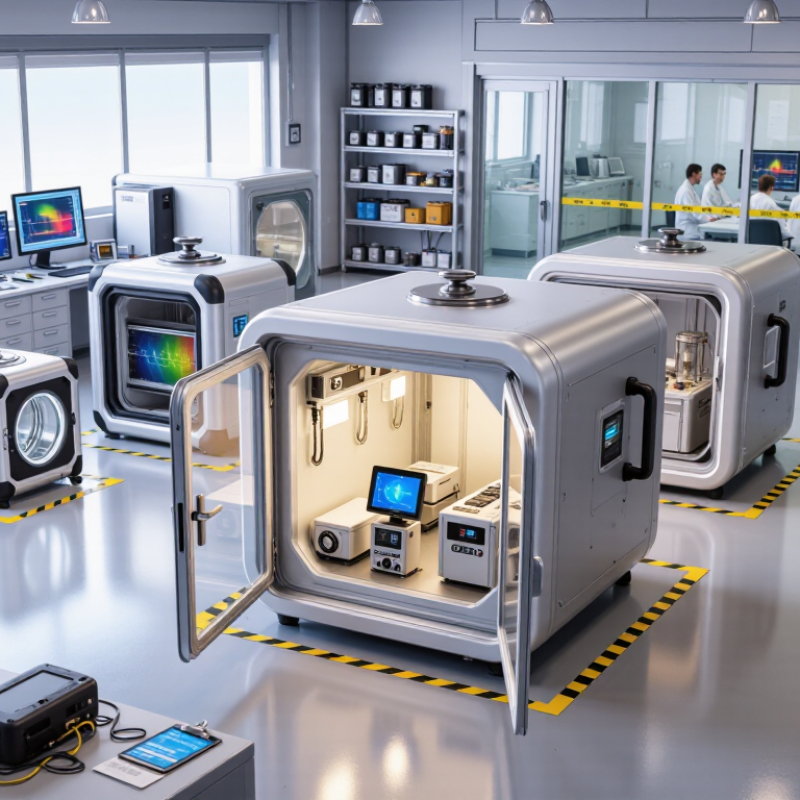
Top Altitude Simulation Chamber Manufacturers for Buyers

Define altitude simulation: 101.3 kPa at sea level and the target test pressure

Altitude simulation recreates the lower air pressure found at higher elevations. The standard sea-level reference is 101.3 kPa absolute. A test target is the pressure the chamber must reach and hold, not simply a height printed on its display. That distinction matters. For example, a 75 kPa target means the chamber’s absolute air pressure should stabilize near 75 kPa.

The altitude equivalent is approximate because it depends on the atmospheric model used. Buyers should confirm whether a manufacturer specifies absolute or gauge pressure, and how the control system handles ramping and stabilization. A chamber may reach a setpoint quickly, yet still vary across the test space. Ask for pressure uniformity data under representative loading, not only an empty-chamber result.

Also review sensor calibration, usable pressure range, leak performance, and recovery after the door opens. These details affect repeatability. A clean altitude label can hide practical differences. I would compare actual pressure records from a similar test cycle; brochures rarely show the whole picture. Even then, your product’s heat output, volume, and test duration may change the result. That part is easy to underestimate.
Compare leading manufacturers by chamber volume, pressure range, and service coverage

Choosing an altitude simulation chamber is a fit-and-support decision, not a vacuum-pump contest. Compare usable test volume, not just the outer dimensions. A bulky fixture, cable bundle, or airflow gap can quickly reduce the space available for a test article. Also check door opening size and feedthrough locations. Small details matter.

ISO 2533:1975 places standard atmospheric pressure at about 22.6 kPa at 11 km altitude. RTCA DO-160G Section 4 describes altitude test conditions for airborne equipment. Buyers should match chamber pressure range and ramp control to their actual test profiles, rather than choose by maximum altitude alone. Check that sensors and recorded data cover the required range. Ask how calibration is documented.

Service coverage deserves equal scrutiny. Compare commissioning, technician response times, spare-part availability, and remote troubleshooting across your operating region. A nearby service team may reduce downtime, but confirm response commitments in writing. One caveat: catalog specifications do not prove performance under your load. Request a witnessed acceptance test with representative fixtures. I would still question any comparison that omits recovery time after a door opening. That omission is easy to overlook.

Altitude Simulation Chamber Pressure Benchmarks

Reference ambient pressure at selected altitudes, useful for evaluating chamber pressure ranges.

Values are approximate standard-atmosphere pressures based on the U.S. Standard Atmosphere 1976. They are environmental reference points, not manufacturer specifications. Compare chamber volume and service coverage separately using verified supplier datasheets.

Assess performance for 30,000-ft simulation, equivalent to about 30 kPa

For a 30,000-ft simulation, assess whether a chamber can hold about 30.1 kPa absolute—not gauge pressure. The U.S. Standard Atmosphere, 1976, published by NOAA, NASA, and the U.S. Air Force, gives the atmospheric reference behind this approximate conversion. Real conditions vary, so a displayed altitude is not enough. Ask for calibrated pressure readings, measurement locations, and stability data near the target.

Watch the chamber during the full test cycle. Can it reach 30 kPa smoothly, maintain pressure with the test article installed, and recover without long delays? IEC 60068-2-13 specifies low-air-pressure test methods, useful when comparing test procedures and reporting conditions. Check how the supplier documents leakage, pressure uniformity, sensor calibration, and door-seal performance. A sensor near the pump may not represent conditions beside the product. Small detail, big difference. Request a test record showing actual pressure over time, not only the programmed setpoint. And consider the awkward case: a chamber may meet the target empty, yet drift when a warm, bulky load is inside. That gap deserves attention.

Check test compatibility with MIL-STD-810H Method 500.6 and ASTM D6653

A chamber’s altitude rating is only the starting point. Buyers should compare its pressure range, pressure-change rate, usable volume, and temperature capability with the test plan. MIL-STD-810H Method 500.6 includes different procedures for storage, operation, and decompression. Choose the procedure that matches the equipment’s real exposure. Not just its label.

Ask manufacturers for test data showing pressure control and stability across the intended working range. Check how the chamber handles cables, sensors, and heat generated by powered equipment. These details can affect results. A chamber that reaches the target pressure may still be unsuitable if the load cannot be monitored safely or consistently. Request calibration records and clarify how test conditions are documented.

ASTM D6653 evaluates how low pressure affects packaging systems, including sealed packages that may swell or leak. Its vacuum test setup differs from testing powered hardware under MIL-STD-810H. Buyers should confirm chamber dimensions, fixture needs, and pressure profiles against the selected procedure and package configuration. Ask for a practical demonstration or a sample test report. Compatibility is not certification. A familiar-looking chamber can still miss a requirement, and specifications alone do not settle every question. A careful review with the test laboratory helps expose gaps before purchase.

Top Altitude Simulation Chamber Manufacturers for Buyers — Check Test Compatibility with MIL-STD-810H Method 500.6 and ASTM D6653
Buyer Evaluation Area What to Compare Across Manufacturers Relevant Test Context Evidence to Request
Standard and edition compatibility Confirm the proposed chamber configuration, control system, and test procedure can support the exact standard, edition, and customer-specific test plan. MIL-STD-810H Method 500.6 addresses low-pressure testing. ASTM D6653/D6653M covers vacuum-method testing of the effects of high altitude on packaging systems. A written compliance matrix identifying the applicable standard, edition, procedure, test parameters, and any deviations.
Test procedure coverage Ask which Method 500.6 procedures the system can run and whether the required pressure profiles can be programmed and recorded. Method 500.6 includes storage/air transport, operation/aircraft, rapid decompression, and explosive decompression procedures. Applicability depends on the test plan. Example pressure-versus-time profiles, procedure-specific operating limits, and a description of how each profile is validated.
Pressure range and control Match the chamber’s usable pressure range and control stability to the specified test conditions, product volume, and loading arrangement. Altitude simulation is produced by reducing chamber pressure; the required pressure is test-plan dependent and should not be inferred from a chamber’s maximum altitude claim alone. Documented absolute-pressure range, control accuracy, uniformity or stability data, sensor locations, and performance under representative load conditions.
Pressure transition capability Check whether evacuation, repressurization, and any required rapid pressure changes meet the test profile without exceeding equipment or sample limits. Rapid and explosive decompression tests require a defined pressure-time sequence. The applicable limits should come from the governing procedure and approved test plan. Demonstrated ramp-rate data, profile repeatability records, valve and pumping-system specifications, and safety interlock details.
Temperature capability Determine whether temperature conditioning is required and, if so, whether it must occur simultaneously with low pressure or in separate steps. Temperature conditions are test-plan specific; a low-pressure chamber does not necessarily provide temperature control as standard equipment. Available temperature range, stability and uniformity data, heating/cooling method, and performance information at the requested pressure.
Usable test volume and payload Compare internal working dimensions, feedthrough needs, fixture clearance, payload mass, and the effect of the load on chamber performance. For ASTM D6653/D6653M, the package or packaging system must fit with suitable clearance and be tested using the specified method and conditioning. Internal working dimensions, payload limits, fixture drawings, port options, and a proposed loading layout for the test article.
Instrumentation and records Review pressure and temperature sensor ranges, sampling rates, calibration status, alarms, and how test data are stored and exported. Traceable records help demonstrate that the specified conditions were achieved and maintained; the required instrumentation should be agreed before testing. Sensor specifications, calibration certificates, sample data logs, alarm/event records, and report format.
Packaging-test suitability Verify that the chamber, fixtures, and operating method suit the package type and the intended ASTM D6653/D6653M test conditions. ASTM D6653/D6653M is packaging-focused. It is not interchangeable with MIL-STD-810H Method 500.6, which addresses environmental low-pressure testing of items. A method-specific test setup proposal, fixture or restraint details, and confirmation of how the package will be monitored and inspected.
Safety and facility requirements Assess chamber-vessel safeguards, door interlocks, pressure relief provisions, operating procedures, service access, and site utilities. Low-pressure operation creates pressure differentials and may require facility-specific provisions. The installation must follow applicable codes and the manufacturer’s instructions. Safety documentation, utility requirements, installation drawings, operator training scope, and preventive-maintenance recommendations.
Acceptance and supplier qualification Compare factory acceptance testing, site acceptance support, commissioning, service response, spare parts, and operator training. Standards compatibility should be verified against the actual test plan; equipment capability alone does not establish that a product has passed a test or is certified. Acceptance-test protocol, commissioning checklist, service and warranty terms, training outline, and a sample final test report.

Evaluate controls, calibration, safety systems, and lifecycle costs

When comparing altitude simulation chamber manufacturers, examine how operators set pressure profiles, ramp rates, and hold periods. Controls should make key settings visible and record changes with timestamps. Ask to see a sample operating log, not just a polished interface. Small drift matters. Confirm that pressure sensors and reference instruments have documented calibration intervals and traceable results. A clear procedure for out-of-range readings helps prevent questionable test data from going unnoticed.

Safety features deserve a hands-on review. Check door interlocks, pressure-limit alarms, emergency venting, and what happens after a power or sensor failure. Ask the supplier to demonstrate alarm behavior under controlled conditions. Test the recovery. A chamber’s purchase price is only one part of its cost. Compare installation needs, staff training, preventive maintenance, calibration services, energy use, and expected replacement parts. Request realistic service intervals and response times. These details can expose trade-offs that a sales sheet may miss. Even careful estimates have limits; operating hours and local support can change the total substantially.